
Jin Seo-yeon’s Oatmeal Mushroom Risotto: Follow the Two-Handful Recipe
Jin Seo-yeon’s oatmeal mushroom risotto uses two handfuls of oats, 400 ml almond milk and 1 tablespoon of red snow crab fish sauce, with mushrooms cooked into the base and a separate balsamic mushroom topping. Below is an English explanation of the KBS Episode 204 recipe, keeping its cooking order and informal oat measure rather than inventing a gram conversion.
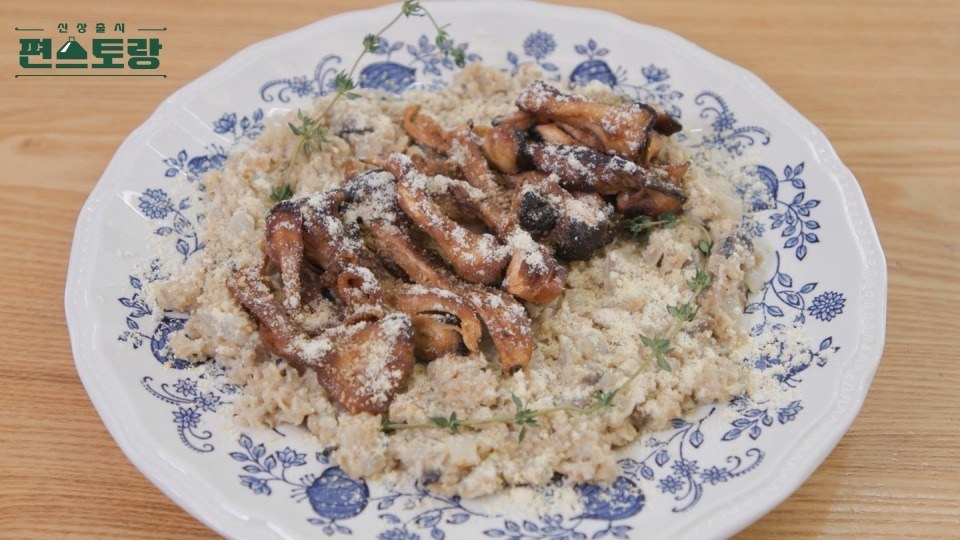
Photo: KBS Fun-staurant, Episode 204.
📌 Original Korean recipe: KBS Fun-staurant official recipe
What ingredients does the KBS recipe specify?
The table follows the KBS recipe. Where that text gives no quantity, the amount remains unspecified; it would be misleading to turn those gaps into a fully weighed recipe.
| Ingredient | Amount in the official recipe |
|---|---|
| Oatmeal | Two handfuls |
| Onion | ¼ onion, finely chopped |
| Solsonggo, enoki and button mushrooms | Amounts not specified; finely chopped |
| Olive oil | 2 tablespoons |
| Almond milk | 400 ml |
| Red snow crab fish sauce | 1 tablespoon |
| Black pepper | A little |
| Parmesan cheese | A little for cooking, plus a finishing sprinkle |
| Thyme | One small piece to finish |
| Chamsongi mushrooms, for the topping | Amount not specified; torn along the grain |
| Butter, for the topping | Amount not specified |
| Balsamic vinegar | 2 tablespoons |
| Allulose | 1 tablespoon |
The Korean ingredient name 홍게 액젓, rendered here as red snow crab fish sauce, matters: the official recipe names this particular seasoning, not simply an unspecified fish sauce. It does not identify a brand, so there is no basis here for recommending a particular bottle.
For the mushrooms, the official text names 솔송고, 팽이버섯 and 양송이버섯 for the chopped base. Enoki and button mushrooms are the English names used here for the latter two; the Korean names for solsonggo and chamsongi are retained to avoid assigning an unsupported variety or retail equivalent.
Allulose appears in the separate topping, alongside balsamic vinegar. It is not added to the almond-milk mixture. The source also explicitly allows mushrooms according to preference, but that permission should not be read as approval for changing every other ingredient.
How do you follow the original cooking order?
1. Prepare the onion and mushrooms. Finely chop the quarter onion and the mushrooms intended for the base. Tear the chamsongi mushrooms for the topping along their grain, keeping them separate from the chopped mixture.
2. Start the chopped mushrooms in a dry pan. The source begins without oil. Stir-fry the chopped solsonggo, button and enoki mushrooms first; when they become partly translucent, add the onion and 2 tablespoons olive oil, then continue cooking.
3. Add the oats after the onion turns translucent. Add the two handfuls of oatmeal and stir-fry them with the mushroom-and-onion mixture. This is the point at which the oats enter—not at the beginning with the dry mushrooms and not after the almond milk.
4. Add the liquid and seasonings together. Pour in 400 ml almond milk, then add 1 tablespoon red snow crab fish sauce, a little black pepper and a little Parmesan. Bring the mixture to a simmer while stirring, following the archived instruction to cook it as you stir.
5. Cook the topping separately. In another pan, cook the torn chamsongi mushrooms in butter. Add 2 tablespoons balsamic vinegar and 1 tablespoon allulose, then stir-fry the topping.
6. Assemble the bowl. Transfer the cooked oatmeal mixture to a bowl and place the mushroom topping over it. Finish with a sprinkle of Parmesan and a small piece of thyme.
The official directions do not give burner settings, a total cooking time or a precise final-thickness test. Those details remain open rather than being replaced here with an untested timer or a promised texture.
What does “two handfuls” mean for measuring the oats?
The recipe uses an informal hand measure, not a specified weight. Neither an exact oat weight nor a measuring-cup equivalent appears in the official text, so “two handfuls” should not quietly become a fixed number of grams in an English version.
That also limits how precisely the recipe can be reproduced from the written directions alone. The text specifies the almond milk in milliliters but leaves the oat quantity dependent on the handful measure, and it does not identify rolled, instant or steel-cut oats.
Optional editorial suggestion—not a KBS direction: if you make the recipe, weigh your own two handfuls and record the oat product you used. That creates a useful note for your next attempt without presenting your measurement as Jin Seo-yeon’s official quantity.
FAQ: What should you know before cooking?
Is this a rice recipe? No rice appears in the official ingredient list or method. The ingredient used at the grain-adding stage is oatmeal; “risotto” is the dish’s name, not an instruction to add risotto rice.
Does the recipe specify sweetened almond milk or a brand? The official text says almond milk and gives 400 ml. It does not specify sweetness, formulation or brand, so this explanation does not select one on the source’s behalf.
Can you leave out the topping? The balsamic mushroom topping is part of the published method. Omitting it would be a personal adaptation, not a complete reproduction of those directions.
How many servings does it make? The official text gives no serving count. With the oats measured by handfuls and several mushroom quantities unstated, a precise yield would be an estimate rather than an official figure.
Before starting, separate the chopped base mushrooms from the torn topping mushrooms—that is one simple preparation step that keeps the two cooking sequences clear.