
Paik Jong-won’s Kimchi Fried Rice: Bacon, Scallion Oil and the Egg Ring
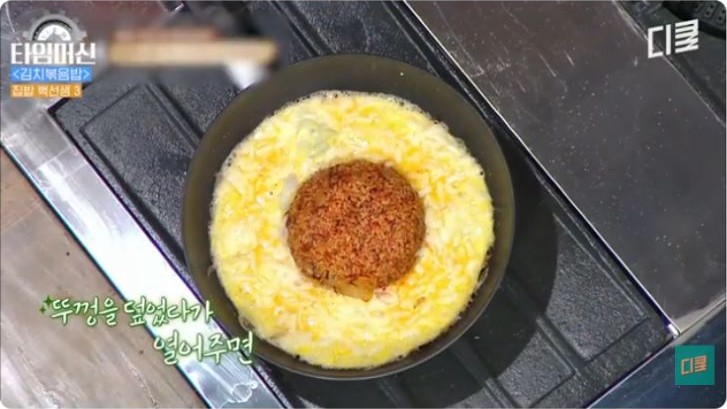
Paik Jong-won’s kimchi fried rice in Home Food Rescue 3 starts with a small detail: chop the bacon and scallions finely enough that their flavor spreads through the rice. In the original cooking clip, he builds scallion oil, lets the bacon release its fat, and adds soy sauce before the kimchi. The finishing touch is a ring of egg and cheese around the rice—a familiar Korean barbecue-restaurant presentation.
What makes this version different?
This is the bacon version demonstrated in the Diggle Classic clip of the show. Paik contrasts it with earlier variations using tuna or sausage. His point is not to add large, obvious pieces of meat. Tiny pieces blend into the rice so that a mouthful tastes fuller without needing a big bacon bite.
Scallions matter just as much. Around 1:45, he explains their role in flavoring the oil, and says the white part gives a stronger aroma. At 2:07, he suggests roughly half a small paper cup of chopped scallions for one bowl of rice. That is the show’s household measure, not a standardized US measuring cup.
Watch Paik cook the original dish →
Ingredients shown in the clip
The main ingredients are cooked rice, chopped kimchi, finely chopped bacon, scallions, cooking oil and soy sauce. Gochugaru, Korean red-pepper flakes, is used to deepen the color. The optional finish uses beaten eggs and cheese.
Paik demonstrates a batch with about two bowls of rice. The clip is a practical cooking lesson rather than a neatly printed gram-by-gram recipe, so this guide follows the sequence and visual cues without inventing exact weights. Use the linked video when matching his household quantities.
1. Build the scallion-and-bacon base
Put the chopped scallions into the pan before turning on the heat, then add oil. Paik explains that this makes it easier to judge the amount of oil around the scallions. He also cautions against starting too aggressively when using frozen scallions.
Add the finely chopped bacon while the scallions are cooking. The bacon fat joins the oil and carries the scallion flavor. Do not rush straight to the rice: around 5:50, he points to the edges of the scallions beginning to turn yellow-golden as an important cue.
2. Add soy sauce before the kimchi
At about 6:17, Paik calls for soy sauce before the kimchi. The hot oil is visibly bubbling when he adds it. He lets it sizzle briefly, then adds the kimchi. This sequence creates the fragrant base before the wetter kimchi enters the pan.
He then stirs in red-pepper flakes to adjust the color and cooks the kimchi before mixing in the rice. Adding gochugaru for a deeper red appearance also changes the heat level; more color is not automatically the best choice for every diner.
3. Break up the rice and mix thoroughly
The rice goes into the cooked base, and the show spends time on mixing rather than immediately serving. Break apart the clumps so that the seasoning reaches the grains. A quick fold that leaves white pockets will not distribute the finely chopped ingredients in the same way.
Before adding anything else, taste the combined rice. Kimchi, bacon and soy sauce all contribute salt, so the final seasoning depends on the ingredients in your own pan. The clip’s useful lesson is the order of cooking and thorough mixing, not a promise that every brand of kimchi will taste identical.
4. Finish with an egg-and-cheese ring
For the restaurant-style finish, Paik asks for three eggs to be beaten. The rice is gathered in the center, leaving space around it for the egg mixture and cheese. He lowers the heat and uses a lid to help the surrounding egg cook.
The result is a central mound of kimchi fried rice with a soft-looking egg-and-cheese border. Watch the end of the video to see how much space is left in the pan. This is an optional presentation step; the rice has already been cooked and tasted before the ring is added.
Questions English-speaking cooks often ask
Is this vegetarian?
No. The demonstrated version contains bacon, egg and cheese. Kimchi ingredients also vary, so a vegetarian adaptation would need separate ingredient choices and would not be the exact version shown.
Is gochugaru the same as gochujang?
No. This clip uses red-pepper flakes to adjust the color, not a spoonful of chili paste. Do not assume the two are interchangeable in the same quantity.
Can I follow it without the egg ring?
Yes. The show finishes and tastes the fried rice before demonstrating that extra presentation. Start with the rice technique if you want to keep the cooking sequence simpler.
Source: Diggle Classic, Home Food Rescue 3 kimchi fried rice clip. Original video and Korean transcript checked October 22, 2026.
Another Korean dish to cook
For a different scallion-based dish, Sung Si-kyung’s chicken jeon combines chicken with a light coating and plenty of scallions. It is a savory pancake rather than fried rice, and the guide explains his actual video sequence.