
Yoon Yoo-sun’s Eggplant Rice Bowl: Why the Sauce Goes In Twice
Yoon Yoo-sun’s eggplant rice bowl uses the same sauce at two different stages: half goes into the pan with water, and the rest goes over the assembled bowl. That makes it both a cooking sauce and a finishing sauce—not two separate mixtures, and not two additions during frying.
📌 Original Korean recipe: KBS Fun-staurant official recipe
Why divide the sauce instead of adding everything at once?
In the KBS recipe for episode 211, the eggplant is browned in oil first. Only then does the recipe call for water and half the prepared sauce, followed by covered cooking for approximately 10 minutes.
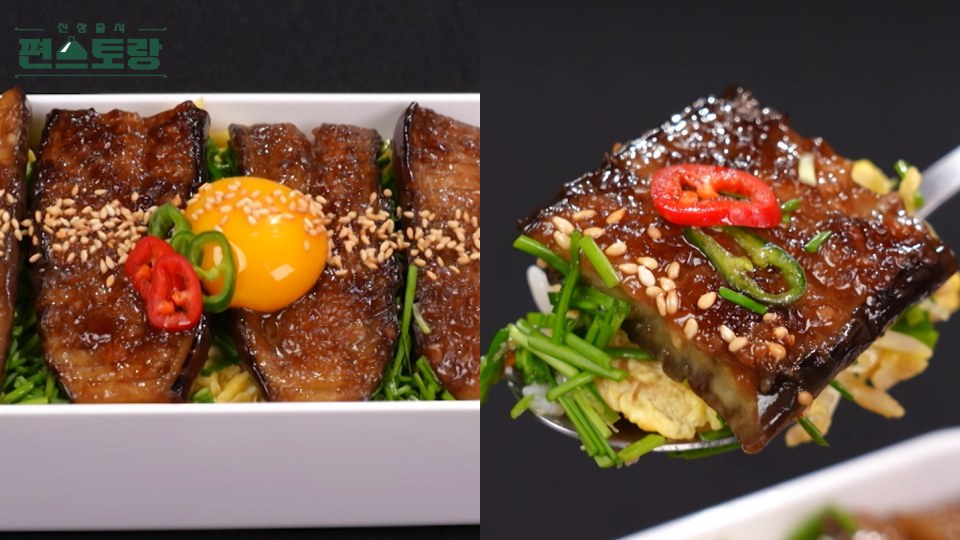
The remaining sauce is added after the rice, cabbage scramble, chives, eggplant, and egg yolk have been arranged. In practical terms, the first portion belongs to the eggplant-cooking stage; the second belongs to the finished bowl.
That is an explanation of the recipe’s structure, not a quoted explanation from Yoon Yoo-sun. The official instructions do not state a scientific reason for splitting the sauce or claim that another method cannot work. If you want to follow this version faithfully, the important distinction is to reserve half rather than pour everything into the pan.
Optional organization tip: Once the sauce is mixed, divide it between two small containers. Label one mentally as “pan” and the other as “bowl.” This is an editorial convenience, not an additional KBS instruction.
What ingredients does the KBS recipe list?
The table below follows the official ingredient list. Quantities that KBS leaves unspecified remain unspecified here; the rice quantity is one bowl, not a measured weight or a guaranteed serving yield.
| Base | 1 bowl cooked rice; 2 eggplants |
| Sauce | 4 tablespoons soy sauce; 4 tablespoons Korean cooking wine, or *matsul* (맛술); 1 tablespoon minced garlic; 2 pieces *yangpadang* (양파당) |
| Covered cooking | 150 ml water, also described as 2/3 cup in the source |
| Cabbage scramble | 1 handful sliced cabbage; 2 eggs; a little salt and pepper |
| Cooking and finishing | Grapeseed oil; finely chopped *yeongyang buchu* (영양부추, small Korean chives); sesame seeds; 1 additional egg, whose yolk is used for finishing |
*Matsul* is the cooking-wine ingredient named in the Korean recipe, not a specified brand. Likewise, the source names a type of chive without giving a measured quantity.
*Yangpadang* literally combines the Korean words for onion and sugar. Here, it is a named preparation measured in “pieces,” but this eggplant recipe does not explain how to make it or how much each piece weighs. Do not interpret “two pieces” as two pieces of ordinary onion. The official recipe explicitly allows 1 tablespoon of sugar instead of the two pieces of yangpadang. This is the practical option if that preparation is unavailable.
What is the correct cooking and assembly order?
Prepare the sauce and vegetables. Mix the soy sauce, cooking wine, minced garlic, and yangpadang. Cut each eggplant in half crosswise, then halve the pieces lengthwise to make four pieces per eggplant; make fairly deep crosswise scores without cutting the pieces apart. Chop the chives and shred the cabbage.
Brown before adding liquid. Heat a pan, add oil, and cook the eggplant until golden with a little charring. The KBS sequence puts this browning step before the water and sauce, so it should not be rewritten as boiling the eggplant from the beginning.
Add only the cooking portion. Lower the heat to medium-low, add the 150 ml water and half the sauce, and mix with the eggplant. Cover and cook in a steam-like manner for approximately 10 minutes, turning the pieces occasionally so they do not burn.
Make the cabbage scramble while the eggplant cooks. Mix the sliced cabbage with two eggs, a little salt, and a little pepper. Cook the mixture in a separate heated, oiled pan, stirring to make the scramble.
Build the bowl in layers. Put the scramble over the rice and scatter over the chopped chives. Add the eggplant and the finishing egg yolk, then sprinkle with sesame seeds and the reserved sauce. The finishing yolk is separate from the two eggs used in the scramble.
Useful questions before you cook
Does the second half of the sauce go back into the pan? No. The official directions place it on the assembled bowl, together with the final sesame-seed garnish.
Should the water be divided too? The source adds the listed water quantity during covered cooking. It does not direct you to reserve any water for finishing.
Do you need onion and green onion as extra vegetables? One preparation line mentions slicing onion and green onion, but the official ingredient list gives no quantities and the cooking steps do not use them. They are therefore not added to this ingredient table or method.
Before heating the pan, set aside the finishing half of the sauce. That single preparation step keeps the recipe’s two-stage seasoning order clear.